Direct answer
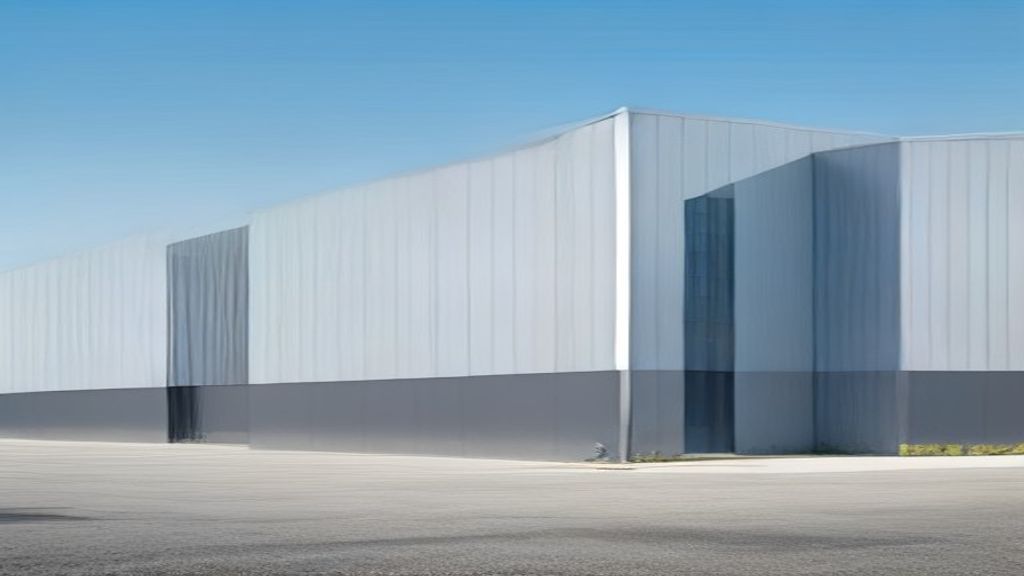
Steel wall cladding is cold-rolled steel sheet protected by a coating stack — a metallic layer of zinc (galvanized) or 55% aluminum-zinc alloy (Galvalume-type), then a primer, then a polyester or PVDF topcoat — formed into profiled, standing-seam, flat, or cassette panels. It is the stiffest and usually the cheapest common cladding metal, which is why it dominates industrial, logistics, and budget commercial walls and any zone that takes impact or hail. The decision logic is exposure-first: every warranty and service-life claim belongs to the coating system, not the steel, so match the metallic coating class and paint film to the environment, detail cut edges and penetrations where the stack is breached, and treat coastal sites as restricted territory unless the manufacturer's published distance-to-coast rules and warranty say otherwise. Weathering steel and stainless steel are different materials with their own decision paths.
Key takeaways
- Coated steel is a four-layer system — steel substrate, metallic coating, primer, topcoat. Every durability and warranty claim belongs to that stack, not to the steel.
- Galvanized zinc sacrifices itself to protect cut edges; 55% Al-Zn coatings last longer in the field of the sheet but protect cut edges less, so edge treatment matters more.
- At the same gauge, steel is stiffer and harder to dent than aluminum. That wins impact zones at grade, long spans, and hail-prone regions.
- Manufacturers publish distance-to-coast limits and warranty exclusions for coated steel. Near salt water, confirm the warranty in writing or change metal.
- Scratches through the paint are cosmetic; scratches through the metallic coating are corrosion sites. Get the manufacturer's touch-up and replacement rules into the spec.
- Site cutting with abrasive discs burns the coating and embeds hot steel particles. Require shears or nibblers and factory-cut edges wherever possible.
- Weathering (corten) and stainless steels are separate materials with separate pages — do not spec them by analogy with coated steel.
| Criterion | Typical range | Note |
|---|---|---|
| Weight | High | ≈ 7.85 g/cm³; strongest common cladding metal |
| Corrosion resistance | Coating-dependent | Galvanized + paint; bare steel rusts |
| Fire behaviour | Non-combustible sheet | Assembly rating depends on full wall build-up |
| Maintenance | Low to medium | Coating inspection; cut-edge touch-up |
| Relative cost | Low | Most economical metal cladding option |
| Impact resistance | High | Best dent resistance of the common cladding metals at a given gauge |
| Thermal movement | Low | Expands noticeably less than aluminum; simpler joints on long runs |
| Magnetism | Ferromagnetic | Magnets hold; useful for temporary fixings and site checks |
| Coastal suitability | Restricted | Manufacturers publish distance-to-coast warranty limits |
Steel is stronger, stiffer, and usually cheaper than the other cladding metals, and it is formed into more profiles. It rusts if the coating fails, so a steel specification is mostly a coating-system specification. Use a lighter metal from the materials hub when weight or coastal air dominate. Association guidance is collected by the Metal Construction Association.
What is the coating stack, and why does each layer matter?
Architectural steel cladding starts as cold-rolled sheet. On top of that substrate sit three layers, and each one has a distinct job.
The metallic coating is the corrosion protection. Hot-dip galvanizing bonds a zinc layer to the steel; the American Galvanizers Association’s process overview describes how the zinc and iron form metallurgically bonded alloy layers rather than a paint-like film. The alternative is a 55% aluminum-zinc alloy coating (Galvalume and equivalents), which trades some of zinc’s sacrificial action for longer barrier life. Either way, this layer — not the topcoat — is what stands between the steel and rust.
The primer is the adhesion and corrosion-inhibiting bridge between metal and paint. It is invisible in the finished wall and decisive in how the paint system ages.
The topcoat — polyester, silicone-modified polyester, or PVDF — carries the color and gloss and shields the layers below from UV and weather. Topcoat chemistry is a finishes decision, covered on metal panel finishes; the exposure class and warranty go back to the whole stack.
Read a coated-steel datasheet in that order. A premium PVDF color over a light metallic coating is a worse wall than a modest polyester over a heavy one.
Galvanized or Al-Zn: what changes at the cut edge?
The two metallic coatings age differently, and the difference concentrates at cut edges, drilled holes, and scratches — everywhere the steel core is exposed.
Zinc is strongly sacrificial: it corrodes preferentially and throws cathodic protection across small areas of bare steel. A shear-cut edge on thin galvanized sheet largely protects itself, which is why galvanized cladding has tolerated site cutting for a century. The tradeoff is that the zinc is being consumed, and consumption speeds up with the atmosphere — the AGA’s atmospheric service-life data ranks industrial and marine environments as the most aggressive.
Al-Zn alloy coatings corrode more slowly in the field of the sheet, which is why they back the longer perforation warranties. But the aluminum fraction passivates rather than sacrifices, so cut edges get less galvanic help; heavier-gauge cut edges and unsealed penetrations can show edge staining earlier than the sheet itself would suggest. Al-Zn sheet also has known incompatibilities — keep it out of contact with wet concrete and mortar, and keep copper, lead, and treated-timber runoff out of its drainage path.
Neither coating is simply better. Galvanized forgives edges; Al-Zn endures surfaces. The detailing burden shifts accordingly, and the corrosion logic behind all of it lives on metal cladding corrosion.
What panel forms does steel take?
- Corrugated and trapezoidal profiles are the cheapest facade cladding in any metal. Profile depth lets the sheet stay thin.
- Standing-seam and concealed-fix profiles hide fasteners.
- Flat and cassette panels are possible, but steel holds flatness less easily than thicker aluminum, so oil canning has to be designed for.
- Steel skins are the usual facing on factory-insulated panels. The systems hub explains how those differ from site-assembled walls.
Where does steel’s stiffness win?
Steel resists dents better than aluminum wall panels at the same gauge, and the same sheet spans further between supports. That decides three situations. Impact zones — the bottom two meters of a wall that meets forklifts, carts, or the public realm — favor steel or demand heavier aluminum. Long spans between girts on big sheds let steel use fewer supports or thinner sheet. Hail-prone regions favor steel skins, because dents that would be permanent in soft aluminum often stay below the visible threshold in steel; where hail governs, ask for the manufacturer’s tested impact data rather than assuming.
Two side properties come along for free. Steel expands roughly half as much as aluminum with the same temperature swing, which simplifies joints and fastener slotting on long elevations. And carbon steel is ferromagnetic — magnets hold temporary protection without penetrations, and a magnet distinguishes steel from aluminum sheet in seconds on site. The full trade-off against aluminum is worked through on aluminum vs steel wall panels.
Where does coated steel fail?
The weight shows up in the subframe, in transport, and on site; renovation work that is tight on load often moves to aluminum. But the real failures are coating-stack breaches. Cut edges, drilled holes, and scratches expose bare steel, so detailing, touch-up discipline, and compatible fixings decide service life more than the datasheet does. Site cutting with abrasive discs is the classic self-inflicted wound: the disc burns the coating at the cut and sprays hot steel particles that embed in the finish and rust as freckles. Shears and nibblers, or factory cutting, are the rule worth writing down.
Coastal air is the boundary condition. Salt accelerates consumption of the metallic coating faster than any paint can compensate, and manufacturers respond by publishing distance-to-coast limits and warranty exclusion zones. The honest specification move is qualitative: identify the site’s exposure, put the manufacturer’s published limits in front of the client, and confirm the warranty applies in writing. Where it does not, upgraded coatings, aluminum, or zinc are the usual answers.
Fire language stays at assembly scale: the sheet is non-combustible, but the rating that matters belongs to the complete tested wall. The design and specification hub covers how to read those claims.
What about weathering steel and stainless?
Two steels deliberately sit outside this page. Weathering steel is bare steel alloyed to grow an adherent rust layer instead of a coating — a different maintenance story, a different runoff problem, and a different aesthetic, handled on corten steel cladding. Stainless steel resists corrosion through its own chromium-oxide film, needs no paint, and costs accordingly; it has its own decision path on stainless steel wall panels. Do not specify either by analogy with coated steel — the failure modes barely overlap.
What should the spec actually say?
Three clauses do most of the work. First, the coating class: name the metallic coating type and weight for the exposure, not just “galvanized” — that word alone specifies nothing. Second, the warranty split: paint warranties come in parts (film integrity versus chalk and fade, and separately the perforation warranty on the metallic coating), and the impressive number in the brochure is usually the least demanding one; state each term explicitly. Third, edge treatment: factory-cut edges where possible, shear or nibbler for site cuts, hemmed or flashed exposed edges, and the manufacturer’s touch-up rules — what may be field-painted and what triggers replacement — quoted, not implied. The checklist above turns these into copy-ready lines.
Choosing steel, elevation by elevation
Steel is rarely an all-or-nothing decision. Run each elevation through the same three questions. What hits it? Grade-level impact and hail argue for steel. What is the air like? Inland and suburban exposure suits standard coated steel; industrial and coastal exposure pushes toward upgraded coatings or a different metal, with the warranty as the referee. Who maintains it? An owner who will inspect and touch up gets decades from coated steel; an owner who will never look at the wall should buy the coating headroom up front. Where budget, spans, and impact dominate and the exposure is known, profiled steel is usually the price every other option is compared against. That fork sits on the comparisons hub, and the wider map is the complete metal wall coverings guide.
Specification checklist
- Name the metallic coating type and class — hot-dip galvanized or 55% Al-Zn — matched to the exposure, not just the word "galvanized".
- Split the paint warranty into film integrity and chalk-and-fade terms, and state both periods.
- State cut-edge rules — factory-cut preferred, site cuts by shear or nibbler only, no abrasive discs.
- Require fasteners with matching or better coating life; no bare steel or dissimilar-metal fixings.
- Confirm distance-to-coast and industrial-exposure warranty conditions with the manufacturer in writing.
- Detail base-of-wall, penetrations, and every horizontal cut where the coating stack is breached.
- Define touch-up limits — what may be field-painted and what damage triggers panel replacement.
- Keep copper, lead, and treated-timber runoff out of the drainage path of Al-Zn coated sheet.
- Ask for tested wall-assembly fire data (NFPA 285 where required), not sheet non-combustibility alone.
Frequently asked questions
How long does coated steel cladding last?
Service life depends on the coating system and exposure. Galvanized steel with a factory-applied paint system commonly carries decades-long coating warranties in normal exposure, but coastal and industrial atmospheres shorten that and need upgraded systems.
Is steel cladding suitable near the sea?
Standard galvanized and painted steel is generally not the first choice within close range of salt water. Upgraded metallic coatings, aluminum or zinc are usually better answers, and manufacturers publish exposure-class guidance that should govern the decision.
What is the difference between galvanized and Galvalume coating?
Galvanized sheet carries a nearly pure zinc layer that corrodes sacrificially and actively protects exposed cut edges. Galvalume-type coatings are roughly 55% aluminum and 45% zinc; they resist general atmospheric corrosion longer in the field of the sheet but give weaker sacrificial protection at cut edges. Neither is universally better — the exposure and the detailing decide.
Will steel cladding rust at screw holes and cut edges?
That is where it starts if the detailing is wrong. Zinc coatings throw sacrificial protection over small exposed edges, which is why thin galvanized sheet tolerates cutting better than thick plate. Correct fastener washers, shear-cut edges, and hemmed or covered exposed cuts keep those points inside the coating system's protection.
Can I touch up scratched steel panels on site?
Only within the manufacturer's rules. A scratch in the topcoat can be touch-up painted for appearance; a gouge through the metallic coating is a corrosion site that paint alone does not fix. Most manufacturers define what is repairable and what requires replacement — put that language in the spec before damage happens.
Is steel cladding magnetic, and does that matter?
Carbon steel cladding is ferromagnetic. In practice that is mostly convenient — magnets hold temporary protection and signage without penetrations, and a magnet is a quick site check to distinguish steel from aluminum or most stainless sheet. It has no bearing on corrosion or structural performance.
Sources
- Metal Construction Association — technical resources — Metal Construction Association Accessed August 25, 2026.
- The Hot-Dip Galvanizing Process — American Galvanizers Association Accessed August 27, 2026.
- How Long Does Hot-Dip Galvanizing Last in the Atmosphere? — American Galvanizers Association Accessed August 27, 2026.